
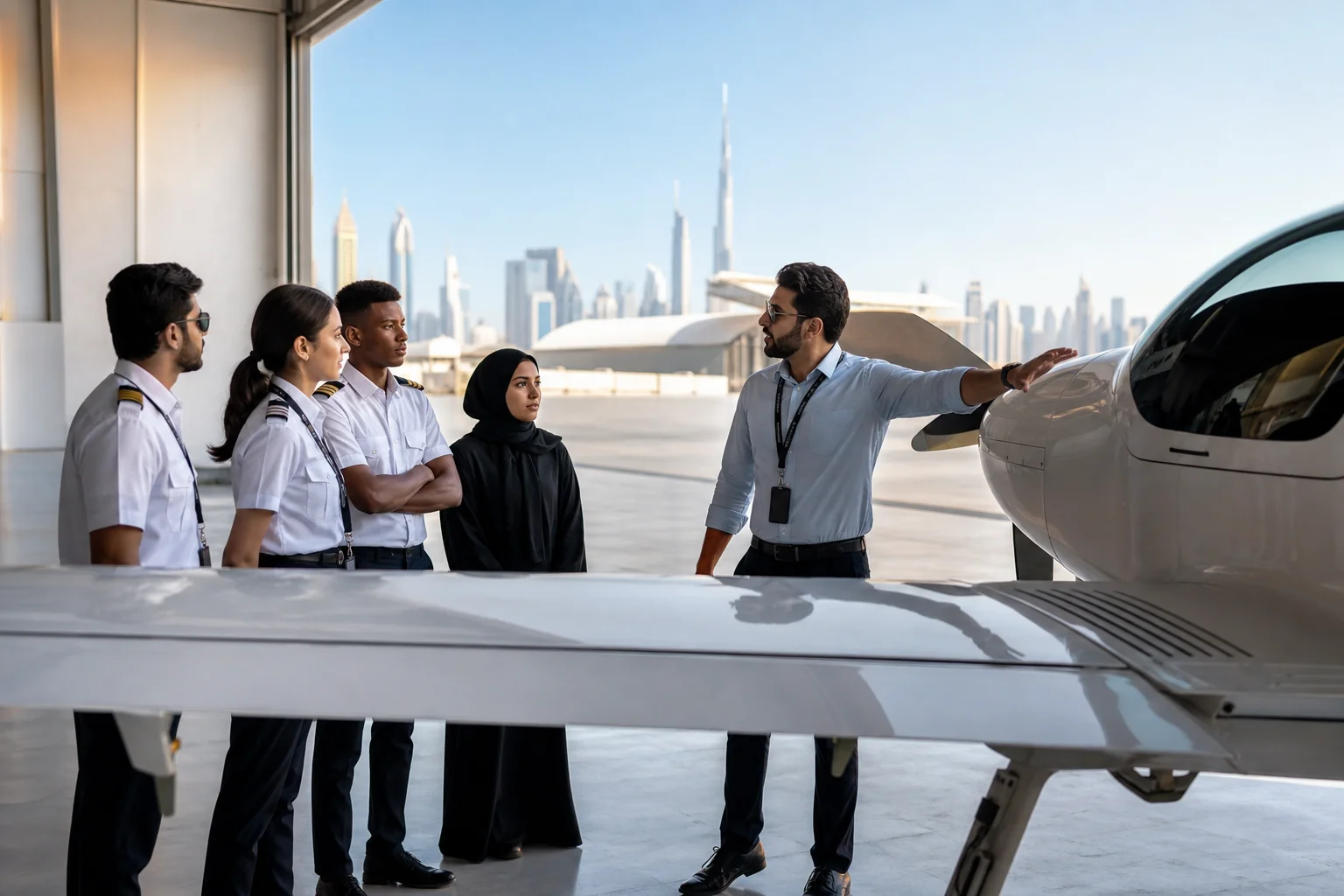
Study Aviation in UAE: Top Universities, Career Prospects, and Fees in 2026
The United Arab Emirates (UAE) has rapidly and indisputably established itself as a premier global aviation hub, a nexus connecting the East and the West, and a powerhouse of aerospace innovation. Home to world-leading, award-winning airlines like Emirates Airlines, Etihad Airways, Air Arabia, and flydubai, the UAE is synonymous with excellence, luxury, and cutting-edge technology in the aerospace sector. For international students, studying aviation in the UAE means immersing yourself in the very center of the industry, surrounded by innovation, massive infrastructure projects, and a booming, highly lucrative job market.
From specialized pilot training and comprehensive aviation management to cutting-edge aerospace engineering and air traffic control, cities like Dubai, Abu Dhabi, and Sharjah offer unparalleled academic and professional opportunities for ambitious students. The UAE’s commitment to the future of flight is evident in its massive investments in infrastructure, such as the unprecedented expansion of Al Maktoum International Airport (DWC), which is set to become the world’s largest airport, with a capacity of over 260 million passengers annually.
This encyclopedic guide will provide you with an exhaustive, deeply detailed look into studying aviation in the UAE in 2026. We will cover the booming aviation sector, exhaustive profiles of top universities, flight academies, detailed admission and medical requirements, and extensive career prospects.
1. Deep Dive into the UAE’s Aviation Boom: Emirates, Etihad, and Dubai’s Role as a Global Aviation Hub
The UAE’s aviation sector is not merely a component of its economy; it is the beating heart of its global connectivity strategy. The nation has successfully diversified its economy away from oil, and aviation stands as one of the most critical pillars of this post-oil economic vision.
The Rise of Emirates Airlines and Dubai International Airport (DXB)
Emirates Airlines, founded in 1985, has grown from a small regional carrier with two leased aircraft into the world’s largest international airline. Operating an exclusive fleet of wide-body aircraft—primarily the Airbus A380 and the Boeing 777—Emirates has redefined air travel. For a student, this means the case studies in your textbooks are happening right in your backyard. Dubai International Airport (DXB) has consistently held the title of the world’s busiest airport for international passenger traffic. The intricate logistics, operations, and management required to run DXB provide an endless learning ground for aviation management students.
Etihad Airways and Abu Dhabi’s Strategic Vision
While Dubai focused on massive volume and global transit, Abu Dhabi, the capital, developed Etihad Airways with a focus on premium experiences, strategic partnerships, and sustainability. Etihad’s Aviation Group is deeply involved in aerospace research, green aviation fuels, and advanced maintenance operations. Abu Dhabi is also home to major aerospace manufacturing components, such as Strata Manufacturing, which produces composite parts for Airbus and Boeing. This creates a massive demand for aerospace engineers and materials scientists in the capital.
The Expansion of Al Maktoum International (DWC)
The future of UAE aviation is undeniably tied to Dubai World Central (DWC) and Al Maktoum International Airport. The government has approved a massive $35 billion expansion plan. Over the next decade, all operations from DXB will shift to DWC, creating an aerotropolis—a city built entirely around an airport. This project alone guarantees decades of job security for civil engineers, airport managers, logistics experts, and air traffic controllers in the UAE.
Low-Cost Carriers: Air Arabia and flydubai
The boom isn’t just in luxury travel. The low-cost carrier (LCC) model has exploded in the region. Air Arabia (based in Sharjah) and flydubai have ordered hundreds of narrow-body aircraft (like the Boeing 737 MAX and Airbus A320neo families) to serve the Middle East, Africa, Europe, and Asia. The growth of LCCs has drastically increased the demand for commercial pilots, cabin crew, and turnaround coordinators.
Sustainability and the Future of Flight
The UAE is at the forefront of aviation sustainability. With initiatives focusing on Sustainable Aviation Fuel (SAF), hydrogen-powered flight research, and carbon-offset programs, studying in the UAE allows students to engage with the technologies that will define the next 50 years of aviation.
2. Exhaustive Profiles of Top Aviation Universities
When it comes to pursuing a degree in aviation, several institutions in the UAE stand out for their specialized programs, industry accreditation, world-class faculties, and exceptional employability rates. Here is a comprehensive breakdown of the top choices.
2.1 Emirates Aviation University (EAU)
Located in Dubai Academic City and established by the Emirates Group, EAU is arguably the ultimate destination for aviation studies in the Middle East. It is fully integrated with the industry’s biggest player, meaning students are directly in the pipeline for one of the world’s best airlines.
- Degrees Offered:
- BSc in Aerospace Technology: Focuses on aircraft design, aerodynamics, and propulsion.
- BSc in Avionics Technology: Specializes in aircraft electronics, navigation systems, and radar.
- BBA in Aviation Management: Covers airport operations, airline economics, aviation law, and strategic management.
- BSc in Air Transport: Merges technical knowledge with operational logistics.
- Postgraduate: MA in Aviation Safety, Aviation Security, and Aerospace Engineering.
- Facilities: EAU boasts an impressive campus featuring fully equipped aerodynamic labs, wind tunnels, Boeing 737 and A380 flight simulators, and materials testing laboratories.
- Industry Ties & Internships: EAU students frequently secure internships directly within the Emirates Group, dnata (the ground handling company), and Dubai Airports.
- Accreditation: Programs are accredited by the UAE Ministry of Education, the UK’s Royal Aeronautical Society (RAeS), and the European Union Aviation Safety Agency (EASA).
- Approximate Annual Tuition: AED 50,000 – AED 70,000.
2.2 Abu Dhabi University (ADU)
ADU offers a highly technical, rigorous, and prestigious Bachelor of Science in Aviation, catering to students who are inclined toward the operational, engineering, and scientific aspects of the field.
- Degrees Offered:
- BSc in Aviation: A comprehensive program that covers flight dynamics, meteorology, air traffic management, and aviation safety.
- BSc in Mechanical Engineering (with aerospace electives): Ideal for students who want a broader engineering degree but plan to work in aerospace manufacturing or maintenance.
- Facilities: State-of-the-art engineering labs, fluid mechanics laboratories, and advanced computer-aided design (CAD) centers.
- Industry Ties & Internships: ADU works closely with Etihad Airways, the UAE Space Agency, and the General Civil Aviation Authority (GCAA). Graduates often find technical roles within Abu Dhabi’s growing aerospace cluster, including GAL (Global Aerospace Logistics).
- Accreditation: ABET accreditation for engineering programs, ensuring global recognition.
- Approximate Annual Tuition: AED 55,000 – AED 75,000.
2.3 Higher Colleges of Technology (HCT)
HCT is the UAE’s largest applied higher educational institution, offering programs with a strong emphasis on hands-on technical skills and vocational training.
- Degrees Offered:
- Bachelor of Applied Science in Aviation Maintenance Engineering Technology (AMET): This is a highly sought-after program designed to produce licensed aircraft maintenance engineers.
- Air Traffic Management (ATM): Specialized tracks for managing airspace safely and efficiently.
- Facilities: HCT campuses feature massive aircraft hangars, actual retired aircraft for hands-on dismantling and repair, and engine overhaul workshops.
- Industry Ties & Internships: Deep ties with AMMROC (Advanced Military Maintenance, Repair, and Overhaul Center) and local airlines.
- Approximate Annual Tuition: AED 45,000 – AED 60,000.
2.4 Canadian University Dubai (CUD)
While primarily known for its business and architecture programs, CUD offers excellent pathways for students interested in the corporate, financial, and logistical side of the aviation industry.
- Degrees Offered:
- BBA in Supply Chain Management and Logistics: Perfect for understanding air cargo, freight forwarding, and airport logistics.
- BBA in International Business: Ideal for those aiming for airline corporate strategy, fleet purchasing, and route planning.
- Approximate Annual Tuition: AED 65,000 – AED 75,000.
2.5 Amity University Dubai
Amity University has carved out a niche by offering specialized aerospace programs in a highly dynamic campus environment.
- Degrees Offered:
- BTech in Aerospace Engineering: A rigorous 4-year engineering program covering rocket propulsion, satellite technology, and aircraft structures.
- Facilities: The campus includes a ground control station, satellite tracking facilities, and aerospace workshops.
- Approximate Annual Tuition: AED 40,000 – AED 55,000.
3. Detailed Breakdown of Flight Academies, Cadet Programs, and Pilot Licensing
For many students, the ultimate goal is the cockpit. Studying a degree in aviation provides the academic background, but becoming a Commercial Pilot requires rigorous flight training and licensing. The UAE is home to some of the best flight schools in the world.
Regulatory Bodies: GCAA, EASA, and FAA
Before choosing an academy, you must understand licensing. The UAE operates under the General Civil Aviation Authority (GCAA), whose standards are heavily aligned with the European Union Aviation Safety Agency (EASA).
- GCAA License: Required to fly for UAE airlines (Emirates, Etihad, etc.).
- EASA License: Highly respected globally, allowing you to fly for European carriers. Many UAE academies offer dual GCAA/EASA licensing.
- FAA License: The American standard. While some academies offer FAA pathways, you will need to convert an FAA license to a GCAA license to fly for a UAE airline.
Top Flight Academies in the UAE
Emirates Flight Training Academy (EFTA)
Located at Al Maktoum International Airport (DWC), EFTA is a world-class facility built by Emirates to train the next generation of global pilots.
- The Program: EFTA offers a comprehensive ab-initio cadet program taking students from zero hours to an Airline Transport Pilot License (ATPL).
- Fleet: Students train on a modern fleet of single-engine Cirrus SR22 G6 aircraft and twin-engine Embraer Phenom 100EV very light jets.
- Facilities: Features its own dedicated 1,800-meter runway, an independent air traffic control tower, rescue and firefighting services, and state-of-the-art full-flight simulators.
- Cost: Approximately AED 600,000 to AED 700,000 for the full ATPL program.
Etihad Aviation Training (EAT)
Based in Abu Dhabi, EAT is one of the largest training facilities in the Middle East, offering both ab-initio pilot training for cadets and type-rating training for experienced airline pilots.
- The Program: The Multi-Crew Pilot License (MPL) program is specifically designed to transition cadets directly into the right seat of an Etihad Airbus or Boeing aircraft.
- Fleet: Cessna 172s, Diamond DA42s, and extensive full-flight simulators for A320, A350, B777, and B787.
Fujairah Aviation Academy (FujAA)
Located in the emirate of Fujairah, this academy benefits from less congested airspace, allowing for more efficient flight training.
- The Program: Offers Private Pilot License (PPL), Commercial Pilot License (CPL), and ATPL ground school.
- Advantage: Often more affordable than Dubai-based academies, with excellent flying weather year-round.
Cadet Programs vs. Self-Funded Training
- Airline Cadet Programs: Emirates and Etihad occasionally open cadet programs where the airline sponsors the training, guaranteeing a job upon completion. However, these are highly competitive and often restricted to UAE Nationals, though international applications open periodically based on demand.
- Self-Funded: International students typically enroll as self-funded cadets. Upon obtaining a frozen ATPL with around 200-250 flight hours, they apply to airlines for First Officer roles.

4. Comprehensive Guide to Admission Requirements and Prerequisites
Getting into an aviation program in the UAE requires careful preparation. Here is an exhaustive list of requirements for international students.
4.1 Academic Requirements
- High School Diploma: You must hold a recognized high school certificate (US High School Diploma, British A-Levels, IB Diploma, CBSE, etc.).
- Equivalency Certificate: International qualifications must be equalized by the UAE Ministry of Education (MoE). This is a crucial administrative step.
- Subject Prerequisites:
- For Engineering/Pilot Programs: Excellent grades in Mathematics and Physics are absolutely mandatory. A background in Chemistry or Computer Science is highly beneficial.
- For Management Programs: A strong overall GPA, with good grades in Mathematics and Business/Economics subjects.
4.2 Language Proficiency
Since aviation is a global industry and the international language of the sky is English, programs in the UAE are taught entirely in English.
- IELTS: A minimum overall band of 6.0 (some engineering programs require 6.5).
- TOEFL iBT: Minimum score of 79-80.
- EmSAT: The UAE’s standardized test (EmSAT English score of 1400+ may be accepted).
4.3 Medical Fitness and Aviation Medical Certificates
If you are pursuing pilot training or Air Traffic Control, standard university admission is not enough; you must pass rigorous medical examinations.
- Class 1 Medical Certificate: Required for all Commercial Pilots. This is a highly stringent medical exam conducted by a GCAA-approved Aeromedical Examiner (AME). It checks:
- Vision: Perfect or easily correctable vision, normal color perception, and depth perception.
- Hearing: Perfect hearing in both ears at various frequencies.
- Cardiovascular Health: ECG tests to rule out heart conditions.
- Neurological Health: No history of epilepsy or sudden incapacitation.
- Psychological Fitness: Mental health evaluations.
- Class 2 Medical Certificate: Required for Private Pilots (less stringent).
- Class 3 Medical Certificate: Required for Air Traffic Controllers (focuses heavily on stress management, hearing, and vision).
4.4 Visas and Accommodation
- Student Visa: Universities sponsor international students for a student visa, which is typically renewed annually. The new UAE Golden Visa system also allows exceptional students (with a GPA above 3.8) to secure a 10-year residency, an incredible advantage for long-term career planning.
- Accommodation: Most top universities offer on-campus housing, which ranges from AED 15,000 to AED 35,000 per year depending on room type (single or shared).
5. Extensive Career Prospects: Roles, Salaries, and Industry Outlook
Graduating with an aviation degree from a UAE institution opens doors to a variety of high-paying, dynamic, and globally recognized career paths. Furthermore, the UAE offers a tax-free income, meaning the salary you earn is exactly what you keep.
5.1 Commercial Pilot (First Officer / Captain)
- The Role: Operating commercial flights, ensuring passenger safety, navigating complex weather systems, and managing advanced aircraft systems.
- Salary Outlook:
- First Officer: AED 25,000 – AED 35,000 per month.
- Captain (Wide-body): AED 45,000 – AED 60,000+ per month.
- Benefits: Housing allowance (often luxury villas for captains), comprehensive medical, education allowance for children, and heavily discounted or free flights globally.
5.2 Aerospace / Aircraft Maintenance Engineer (AME)
- The Role: Aerospace engineers design and test aircraft modifications. AMEs are on the ground, conducting line maintenance, heavy checks (C and D checks), and certifying that an aircraft is safe to fly. You cannot fly a plane without an AME signing it off.
- Salary Outlook:
- Junior Engineer: AED 15,000 – AED 20,000 per month.
- Licensed AME / Senior Engineer: AED 30,000 – AED 45,000 per month.
5.3 Air Traffic Controller (ATC)
- The Role: Managing the safe and orderly flow of air traffic. This is a high-stress, high-responsibility job requiring immense concentration and spatial awareness.
- Salary Outlook: ATCs in the UAE are highly compensated due to the complexity of the airspace. Salaries range from AED 35,000 to over AED 55,000 per month for senior radar controllers, alongside exceptional benefits.
5.4 Aviation Management and Airport Operations
- The Role: This covers a vast array of jobs: Airport Duty Manager, Airline Route Planner, Fleet Acquisition Manager, Ground Handling Manager, and Cargo Logistics Director. They ensure the business of the airline and airport runs profitably and smoothly.
- Salary Outlook:
- Entry-Level (e.g., Turnaround Coordinator): AED 10,000 – AED 15,000 per month.
- Mid-Level Manager: AED 25,000 – AED 35,000 per month.
- Executive Level: AED 60,000+ per month.
5.5 Aviation Law and Safety Regulation
- The Role: Working with the GCAA or airline legal departments to ensure compliance with international aviation laws, investigating safety incidents, and managing risk.
- Salary Outlook: Highly specialized, with salaries ranging from AED 30,000 to AED 50,000+ per month.
6. Get Started on Your Aviation Journey
The aviation sector in the UAE is not just recovering from global shifts; it is expanding at an unprecedented, historic rate. With the massive expansion of Al Maktoum International Airport and the continuous fleet orders from local carriers, there will be a shortage of aviation professionals in the coming decade.
If you are passionate about airplanes, complex airport operations, aerospace engineering, or the dynamic business of global travel, there is absolutely no better place on Earth to earn your degree and launch your career.
Navigating university choices, visa applications, medical requirements, and program specifics can be overwhelming. You don’t have to do it alone. Need help choosing the right university or navigating the application process? Contact Right Step today for a free, comprehensive consultation and let our expert educational consultants guide you toward a soaring, successful career in the UAE!

7. Massive FAQ: Everything You Need to Know About Studying Aviation in the UAE
Here are detailed answers to the 15 most frequently asked questions about pursuing aviation studies in the Emirates.
Q1: Are aviation degrees from the UAE recognized internationally? A: Absolutely. Degrees from top institutions like Emirates Aviation University and Abu Dhabi University are fully accredited by the UAE Ministry of Education. Furthermore, they hold international recognition from prestigious global bodies like the UK’s Royal Aeronautical Society (RAeS), ABET (for engineering), and the European Union Aviation Safety Agency (EASA). Your degree will be valid and respected globally.
Q2: Can I become a pilot just by studying an aviation degree at a university? A: No. A Bachelor’s degree in Aviation or Aerospace Technology provides an excellent, highly regarded academic foundation. However, to become a commercial pilot, you must complete practical, hands-on flight training and obtain a Commercial Pilot License (CPL) or Airline Transport Pilot License (ATPL) from a GCAA-approved flight academy like Emirates Flight Training Academy or Fujairah Aviation Academy.
Q3: Are there scholarships available for international students studying aviation? A: Yes. Many universities, including ADU, CUD, and Amity University, offer generous merit-based scholarships for international students who demonstrate exceptional academic performance in high school. These can range from 10% to 50% off tuition fees. EAU also offers discounts for alumni and specific corporate partners.
Q4: What is the average salary for aviation graduates in the UAE? A: Salaries vary widely by role but are highly competitive and tax-free. Entry-level aviation management roles typically start around AED 10,000 to 15,000 per month. Highly technical roles like Aerospace Engineers or Air Traffic Controllers start higher (AED 20,000+), and senior Captains or Executive Managers can earn well over AED 50,000 per month, plus housing and flight benefits.
Q5: Is it easy to find a job in the UAE after graduating with an aviation degree? A: The UAE boasts one of the fastest-growing aviation markets in the world. Graduates from local universities, especially those with strong industry ties like EAU, often have excellent employment prospects. Regular campus recruitment drives by Emirates Group, dnata, and Dubai Airports provide direct pathways. While competition is fierce, local graduates are highly preferred.
Q6: What is a Class 1 Medical Certificate, and why do I need it? A: A Class 1 Medical Certificate is a mandatory health clearance required for anyone who wishes to fly commercially. Conducted by a GCAA-approved Aeromedical Examiner, it rigorously tests your eyesight, hearing, heart health, neurological status, and psychological fitness to ensure you are safe to operate a commercial aircraft.
Q7: Do I need to know Arabic to study aviation or work in the UAE? A: No. The global language of aviation is English. All university programs, flight academy communications, Air Traffic Control operations, and technical manuals in the UAE are strictly in English. While knowing Arabic is a cultural bonus and helpful in daily life, it is not required for your studies or your aviation career.
Q8: What is the difference between EASA, FAA, and GCAA pilot licenses? A:
- FAA: Federal Aviation Administration (USA standard).
- EASA: European Union Aviation Safety Agency (European standard, known for very rigorous theory exams).
- GCAA: General Civil Aviation Authority (UAE standard). To fly a UAE-registered aircraft (like an Emirates A380), you must hold a GCAA license. Many UAE schools offer GCAA licenses that are heavily aligned with EASA standards, making conversion to a European license easier if you decide to work in Europe later.
Q9: Can females study aviation and become pilots in the UAE? A: Absolutely. The UAE heavily encourages women in aviation. Airlines like Emirates and Etihad employ hundreds of female pilots, engineers, and executives. Universities have high female enrollment in aerospace engineering and aviation management, and the UAE actively celebrates Emirati Women’s Day with a focus on women breaking barriers in aerospace.
Q10: How long does it take to get a Commercial Pilot License (CPL) in the UAE? A: If you enroll in a full-time, intensive ab-initio program (zero hours to frozen ATPL/CPL), it typically takes between 18 to 24 months. This includes hundreds of hours of ground school theory and approximately 200-250 hours of actual flight and simulator time.
Q11: What are the mathematics and physics requirements for aerospace engineering? A: Aerospace engineering is heavily reliant on advanced math and physics. You must have top grades (usually 80% or higher, or A/B grades in A-Levels) in Calculus, Algebra, and Physics. You will study advanced fluid dynamics, thermodynamics, and structural mechanics, so a strong high school foundation is non-negotiable.
Q12: Is it possible to work part-time while studying aviation in the UAE? A: Yes, the UAE recently updated its visa laws allowing university students to work part-time, provided they obtain a permit from the Ministry of Human Resources and Emiratisation (MOHRE). Internships at aviation companies are highly encouraged and are often built into the curriculum.
Q13: What is the cost of living for aviation students in Dubai or Abu Dhabi? A: Beyond tuition, students should budget approximately AED 3,000 to AED 5,000 per month for living expenses. This includes shared accommodation (AED 1,500 – 2,500), food, transport (using the excellent Dubai Metro), and personal expenses. Flight students should also budget for extra simulator hours or exam fees.
Q14: Can I transition from military aviation to commercial aviation in the UAE? A: Yes. Many ex-military pilots and maintenance engineers transition into the commercial sector. However, military pilots must still undergo specific bridging courses and obtain their civilian ATPL and specific aircraft type ratings to fly commercial airliners.
Q15: What are the future trends for the UAE aviation job market? A: The future is incredibly bright. Key growth areas include drone logistics (Urban Air Mobility), sustainable aviation fuels, advanced aerospace manufacturing (composite materials), and massive airport management roles as DWC expands. The demand for tech-savvy aviation professionals, data analysts, and robotics engineers in aviation is skyrocketing.




 English
  Russian