
Medical Education in the UAE: Admission, Universities and Requirements
Medicine is one of the most demanding fields in higher education. A university should not be chosen only because the campus looks impressive. Medical education in the UAE can be a strong start for a future doctor, but only if the family checks the programme, admission requirements, accreditation, costs and long-term route to clinical practice.
The UAE continues to develop healthcare, medical clusters and clinical education. Future doctors study in English, work through laboratory and clinical modules, and later move towards internship and professional licensing requirements. For international students, this route can be attractive, but it is serious and should not be planned casually.
How Medical Programmes Are Structured
In the UAE, medical programmes may carry names such as MD or MBBS. The structure depends on the university, but medical education usually combines basic sciences, clinical disciplines, practical training, simulations and hospital exposure. For example, MBRU describes its Doctor of Medicine as a six-year full-time programme, while Gulf Medical University describes a six-year Doctor of Medicine programme accredited by CAA.
A medical programme is not like a regular undergraduate degree. Students face demanding exams, patient scenarios and strict professional ethics. Admission teams therefore assess not only grades, but also maturity, discipline and readiness for a long academic route.
Who Medical Education in the UAE Suits
Medicine suits students who are ready for a long path: strong grades in biology, chemistry, mathematics and physics, academic English, competitive admission and future licensing steps. If the school background is not yet strong enough, a university may recommend a preparation route or a broader health sciences direction.
Students applying after high school should also read the guide to UAE admission after grade 11. It helps families understand direct entry, foundation routes and document timing.
Universities and Programmes: What to Check
In medicine, the programme status matters as much as the university name. In the UAE, CAA is the federal body responsible for programme accreditation. In Dubai, KHDA is also important for higher education institutions under its jurisdiction.
| University | Example programme | What to verify |
|---|---|---|
| Mohammed Bin Rashid University of Medicine and Health Sciences | Doctor of Medicine, 6 years | Requirements, deadlines, tuition, transfer policy |
| Gulf Medical University | Doctor of Medicine, 6 years | CAA accreditation, programme structure, clinical base |
| University of Sharjah | Medicine and health programmes | Current fees, college rules, admission requirements |
| Khalifa University | College of Medicine and Health Sciences | Admission model and previous education requirements |
MBRU states that its MD programme does not accept credit transfer or recognition of prior learning because of the integrated structure of the curriculum. This is an important detail: a student who has already studied medicine elsewhere cannot automatically expect to enter the middle of a programme.
Admission Requirements

Requirements differ by university, but the principle is clear: medicine requires strong school preparation. MBRU publishes requirements for different school systems, English language proof and documents. Its MD page has specific IELTS Academic conditions, while other universities may set different standards.
Most applicants need a school certificate, senior-year records, English proof, passport, photo, sometimes a test, interview and motivation-related materials. Medical admission should always be checked against the official programme page. For general preparation, use the guide to documents for university admission in the UAE.
Costs, English and the Long Route
Medicine is usually one of the most expensive study directions. MBRU lists an annual tuition fee for its MD programme and separate application or seat reservation fees. Other universities may have different amounts and fee structures. That is why it is better to avoid broad "average cost" claims and calculate the budget by programme.
| Cost item | Why it matters | Comment |
|---|---|---|
| Tuition | Main part of the budget | Check the programme page and offer letter |
| Application and deposit | Often non-refundable | Confirm refund conditions |
| Visa and Emirates ID | Required for international students | Depend on sponsorship and university rules |
| Insurance and medical checks | Part of the visa process | May be included in a visa package |
| Housing and transport | Significant annual cost | Calculate separately from tuition |
For a first estimate, use the guide to the cost of studying in Dubai. For medicine, families should build a budget with a margin. English is also critical: students must read scientific material, write reports and communicate in a medical environment. Preparation for IELTS, TOEFL or another accepted test should begin early.
How to Evaluate a Medical University

| Criterion | Why it matters | What to ask |
|---|---|---|
| Accreditation | Affects recognition and trust | Which body accredits the programme? |
| Clinical base | Shows the quality of practice | Which hospitals or clinical settings are used? |
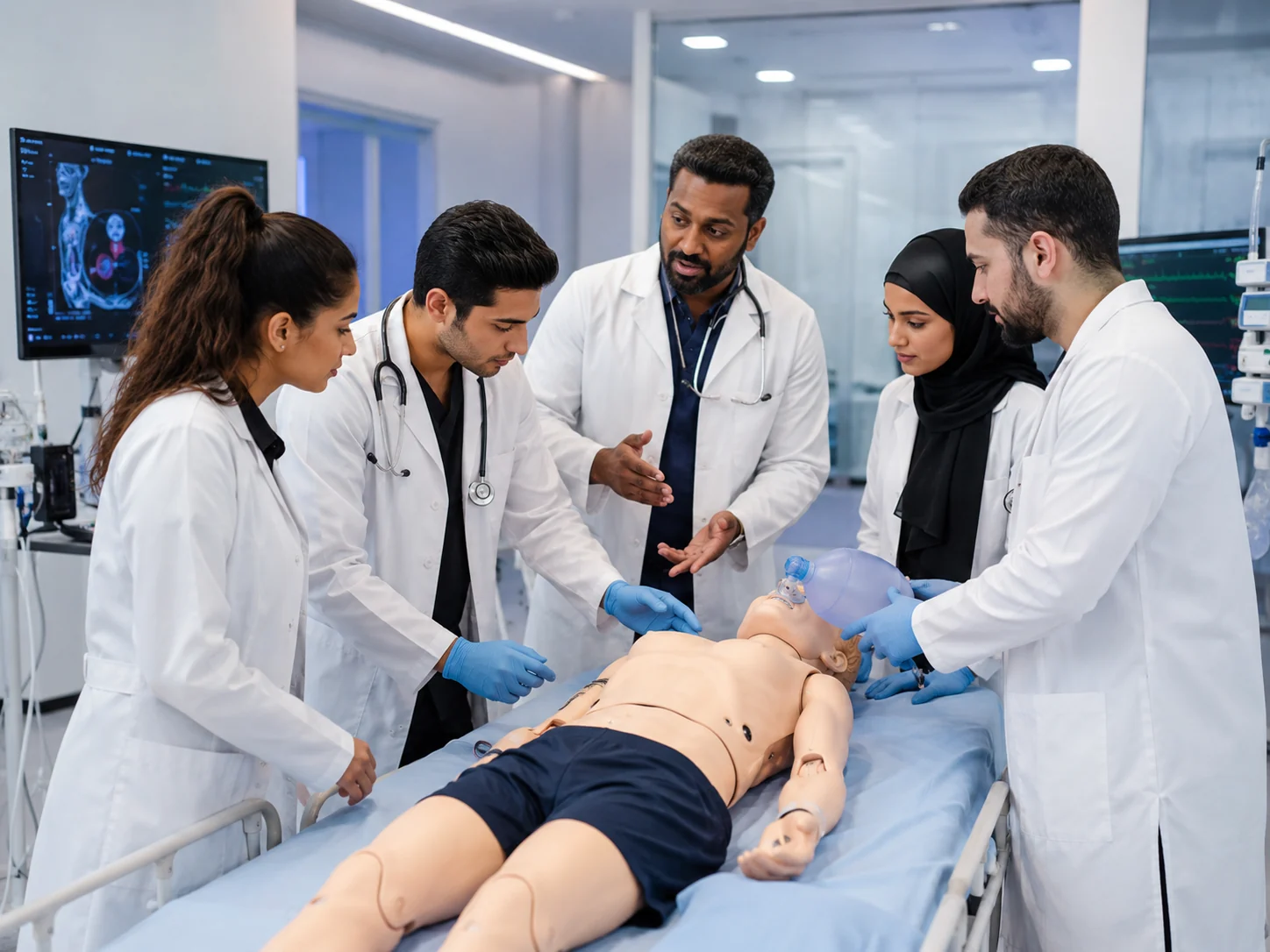
| Simulation facilities | Prepare students for patient scenarios | Which labs are available to students? |
| English requirements | Without English, study becomes difficult | Which tests are accepted and by what date? |
| Route after graduation | Important for licensing | How are internship and further practice structured? |
The strongest choice is not always the most famous name. It is the programme that matches the student's academic level, budget, long-term country plans and willingness to follow a demanding professional path.
Documents and Preparation Timeline
A realistic preparation route may look like this:
- Twelve months before application – choose target universities and check accreditation.
- Nine months before application – start IELTS, TOEFL or other English preparation.
- Six months before application – collect school records and passport documents.
- Three to four months before application – prepare motivation materials and check deadlines.
- Before payment – confirm tuition, deposit rules, visa process and programme structure.
This does not guarantee admission, but it reduces avoidable delays. It also helps families decide whether direct medical entry is realistic or whether another health-related route is more suitable.
When a Related Health Field May Be Better
Not every student interested in medicine must become a doctor. If grades in chemistry and biology are average, English is still weak, or the family is not ready for a long and expensive route, related areas may be worth considering: biomedical sciences, public health, laboratory sciences, healthcare management, psychology or pharmacy.
This is not automatically easier or worse. It simply has to match the student's ability, budget and family plan. A medical route is prestigious, but it requires strict preparation and emotional resilience.
How Right Step Helps with Medical Education in the UAE
Right Step helps families understand medical education in the UAE without rushing or building false expectations. We review the school system, grades in relevant subjects, English level, deadlines, university requirements and accreditation rules. In medicine, this check is especially important because a poor programme choice can cost not only money, but years.
The team helps compare medical universities, prepare document lists, check English requirements, estimate the budget and understand whether the route after high school is realistic. If direct entry into medicine looks too risky, we discuss related fields and preparation routes that may fit the student's current level better.
Right Step does not promise admission and does not simplify strict requirements. Our role is to give the family a clear picture: which programmes fit, where extra steps are needed, which deadlines matter and what questions must be asked before applying.
FAQ
Can international students study medicine in the UAE after high school?
Yes, if the school system and grades meet the university requirements. Some students may need a preparation route or additional academic confirmation.
Can I transfer into a medical programme in the UAE?
Not always. For example, MBRU states that its MD programme does not accept credit transfer. Other universities must be checked separately, but medicine is usually less flexible than business or IT.
Is IELTS required for medical education in the UAE?
Usually, yes. Universities may accept IELTS, TOEFL, EmSAT or another recognised English proof. Minimum scores depend on the university and intake year.
How long does medical education in the UAE take?
Many school-leaver medical routes take around six years, but the exact structure depends on the university. Internship and licensing steps may follow.
Can students get scholarships for medicine?
Sometimes universities offer discounts or scholarships, but medicine often has separate rules. Families should check the exact programme, because some awards may not apply to medical degrees.
Read Next
Medical education in the UAE requires connected planning: admission, documents, English proof, costs, visa and university choice all affect the final decision.
- UAE admission after grade 11
- Documents for university admission in the UAE
- IELTS requirements for UAE universities
- Cost of studying in Dubai
- UAE student visa guide
- How to choose a university in Dubai and the UAE
Official Sources to Check
- MBRU: Doctor of Medicine – programme structure, English requirements, fees and transfer policy.
- Gulf Medical University: Doctor of Medicine – programme structure and CAA reference.
- CAA Accredited Programs – accredited higher education programmes.
- University of Sharjah: Tuition and Fees – fee information.
- u.ae: Residence visa for studying in the UAE – official student residence visa guidance.




 English
  Russian